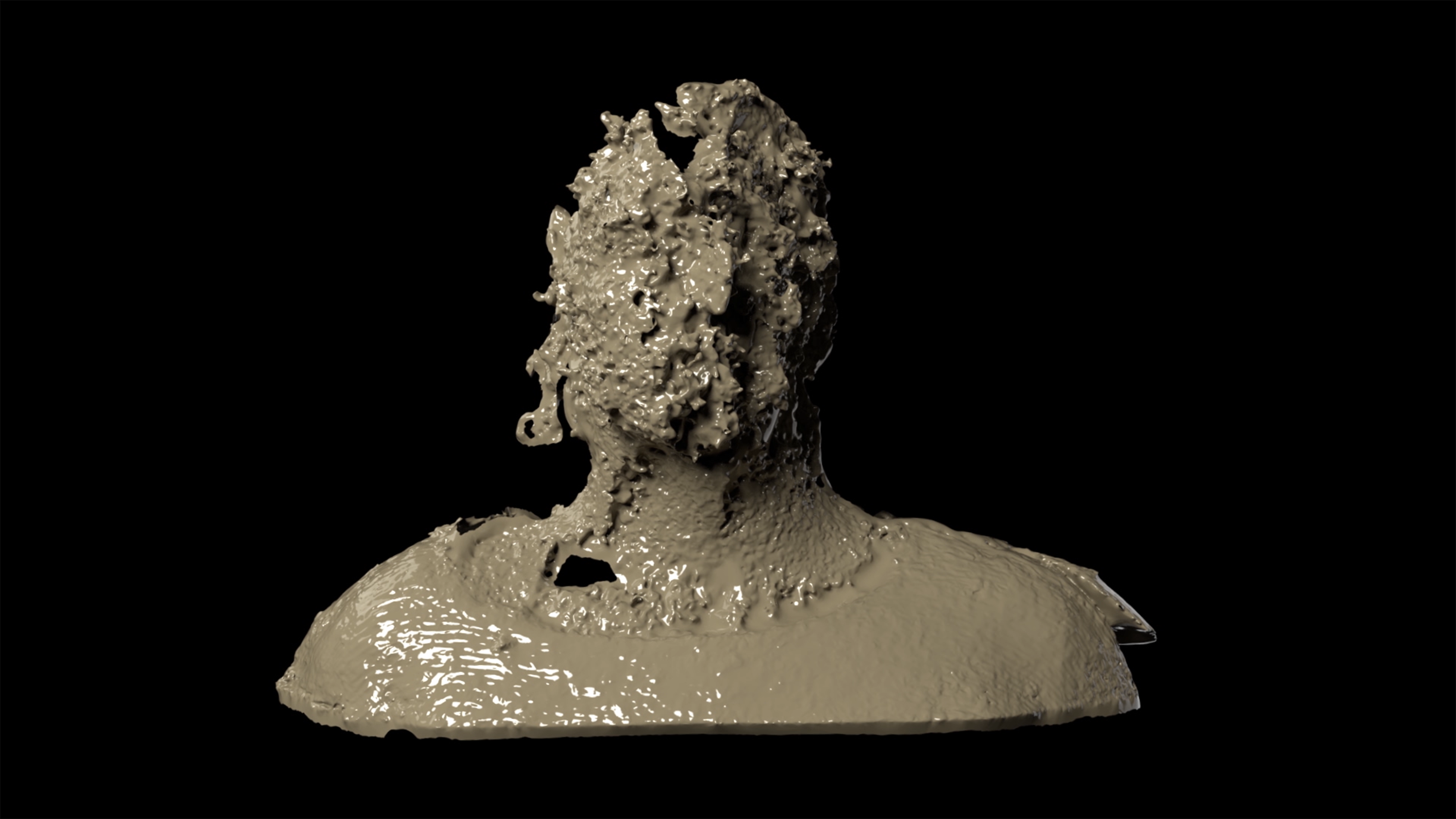
Choreographies of Retreat
2026
Solo exhibition at Reisig and Taylor Contemporary in Los Angeles. Duration: March 07 - April 04, 2026. Spring.


Reisig and Taylor Contemporary is presenting Choreographies of Retreat by Ryat Yezbick. This exhibition continues their ongoing project The Innocence of Unknowing (2020–present), which premiered at the 2025 Tribeca Festival Immersive program as an archival documentary, essay film, and live performance in collaboration with Milo Talwani and a specially trained AI humanities scholar named “Aurora.” For this installation of the project evolved (site-specifically) for the gallery at 603 N Western Avenue in Los Angeles, the expanded cinematic work extends through new video and performance pieces, as well as sculpture and photographic media.
Developed through archival analysis of mass shootings in the United States, the social, historical, and geopolitical scope of the project rewinds from the present moment to the mid-1960s—spanning more than 700 news clips over nearly 60 years (starting with the University of Texas at Austin “tower shooting” in 1966). But the work is not primarily engaged with the accumulation of this footage, nor the particular violence or criminal status of the perpetrator of these events. Instead, the problems and questions guiding the project are focused on the optics, medias, technologies, rhetorics, controls, and repeated (bodily) gestures embedded within—and circulating throughout—the sensationalized scenes and selective documentations of mass shootings in the U.S.: “By removing perpetrators entirely, the project shifts attention to the relationship between the state, victims, and spectators, asking how U.S. media culture repeatedly stages innocence, compliance, and authority.” With this shift, the work unwinds the vulnerable place of a body along these discrete but interconnected positions and discourses of collective memory, media coverage (‘news’), mass surveillance, and “choreographies of retreat”—or, “the repeated bodily gestures—hands raised, bodies herded, movement arrested—that appear across decades of crisis footage.”
At the same time, this project necessarily works-through the complex translations between events, spectacles, records (or accounts), and the public distribution of information as visual materials and languages. These problems of translation and transmission pose questions of how we (as spectators, observers, viewers, audiences) see ourselves watching, or watch ourselves looking—questions about the kinds of mirrors we make and shatter through a collective un/consciousness of mass shootings and gun violence. Questions of how we are conditioned and what we are taught through repetitions of mass watching. Questions of why these events are seen and categorized the way they are. (For example, why are ‘mass shootings’ marked as distinct from acts of terrorism?) Here, the role of the mirror is performed by Aurora the AI humanities scholar developed for the project through a training based on a series of humanities texts. Usually, or at least at the level of its corporate-industrial complex, AI is a data-sorting tool and a predictive model (and, more and more often, a weapon of mass surveillance). However, Aurora’s humanities-based training sets up the possibility of working with AI as an ethical envoy into our own systems of power, with its education “enabling it to generate frame-level analysis and metadata [of the archival footage] that foreground structural power, racialization, and normativity.” A mirror for the frame-by-frame mis en abyme of the ‘mass’ populating any individual reality (and its choreographies between others).
Between these tangled systems, subjects, and scenes, the variable mediums of the exhibition make-room for what is usually pushed beyond the gazed boundaries of ‘the picture,’ collapsing the media’s forgetful distance between audiences and victims. Making-room for kinds of collective memory that are not pre-fabricated en masse, making-room for a conscious, desublimated and non-passive processing of the violence of mass shootings—and “the fear, flight, and immense sorrow and pain”—they inflict and portray. Between a lived experience and its doubles.
Upcoming | Current
Solo Exhibition at Reisig and Taylor Contemporary
The Innocence of Unknowing at Khoj, New Dehli, in Are You Human?
Recent
The Innocence of Unknowing at Tribeca Film Festival (Immersive)
Workers Fleeing the Factory in MIMESIS Magazine
grip at other others // rehearsals in the skin at Human Resources
Contact: ryat.yezbick [at] gmail.com
Photography: Hagen Betzwieser, Keelan O’Hehir, Jessica Wittman, Panayiotis Tsangas, Cedric Tai, Eleni Maligoura, Zach Korol-Gold, Gabriel Sweet, Jen Gilomen
Copyright @2022 Ryat Yezbick. All rights reserved.
Solo Exhibition at Reisig and Taylor Contemporary
The Innocence of Unknowing at Khoj, New Dehli, in Are You Human?
Recent
The Innocence of Unknowing at Tribeca Film Festival (Immersive)
Workers Fleeing the Factory in MIMESIS Magazine
grip at other others // rehearsals in the skin at Human Resources
Contact: ryat.yezbick [at] gmail.com
Photography: Hagen Betzwieser, Keelan O’Hehir, Jessica Wittman, Panayiotis Tsangas, Cedric Tai, Eleni Maligoura, Zach Korol-Gold, Gabriel Sweet, Jen Gilomen
Copyright @2022 Ryat Yezbick. All rights reserved.